Friday, April 3, 2015

CALINAWAN CAVE, Tanay: An Arena for Settling Disputes and Sanctuary for a Doomed Empire

Many of our life's outdoor adventures are the result of a spur-of-the-moment decision.  While we frequent Tanay for its natural serene ambiance, we opt to travel the distance from Dasmarinas instead of the nearer Tagaytay, because Cavite's premiere tourist spot has become too anthropocentric for us nature-loving people.  In every exploration we've been too, I always have the inclination to draw out some lessons in ecotourism. This trip to Calinawan Cave is a good example of revealing some of the advantages and disadvantages of ecotourism.
Practicing the widely accepted definition of ecotourism is the "responsible travel to natural areas that conserves the environment and improves the well-being of the local people." While there is a growing delineation between conventional tourism and ecotourism, the former often uses the latter to serve their purpose.  While using ecotourism receives constant praise for its efforts in promoting sustainable practices and contributing much-needed revenues to some of the country's poor areas, some question its total benefit.
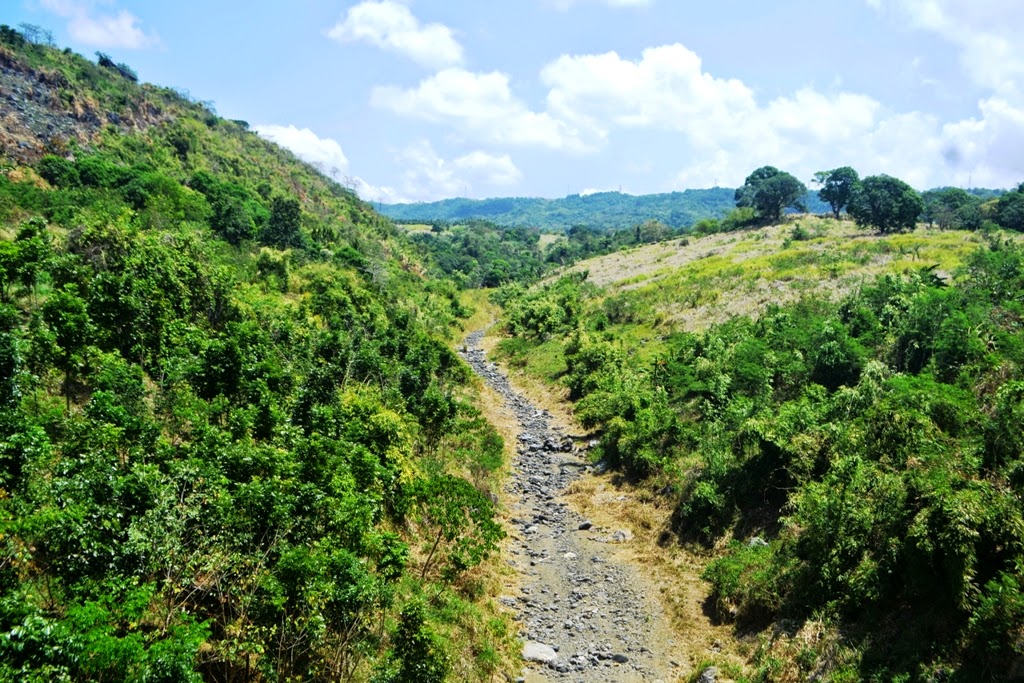
Despite the proximity of Tanay to Metro Manila, this upland region of this Rizalian town still enjoys a degree of immunity from the anthropocentric teeth of tourism.  We're glad that this is the status quo and fervently hope it stays this way indefinitely long into the future.  Although much of the trees and vegetation of its hills are secondary courtesy of deforestation, the succession still brought a new picture of agricultural landscape that is still breathtakingly beautiful.
Calinawan Cave is an off-road challenge to anyone who wishes to visit.  It's a 5 kilometer rough road drive beginning from the junction where it intersects with Daranak Road with occasional pavements in certain parts.  It could also be approached by trekking starting from Daranak Falls along a 1.2 kilometer stretch of uphill climb through forest and agricultural lands. Overall, the cave still enjoys a bit of obscurity and seclusion due to the difficulty of reaching it unlike the Pamintinan Cave in Montalban which is very accessible to virtually everyone.  The community has no public utilities such as electricity and tap water and no regular public transport plying the route.  
There is no cellphone and wi-fi signal and the interior of the cave is pitch black so bring your own flashlight or rely on the tour guide's light.  Best to explore in the morning as the temperature of the cave's interior becomes unbearable in midday.  My Vios Spitfire once again took on the challenge and once more survived the grueling journey.  For those who opt to use public transport, you may rent a tricycle and experience a crazy cross-country ride from your skillful tricycle driver.  Just make sure to make the driver waits while you explore the cave because that will be your ticket out, unless you want to walk back to civilization.
Upon reaching the jump off point,you will be cordially greeted by a guide from the TTMO (Tanay Tourism Municipal Office.  The TTMO prohibits unguided exploration of the cave because of vandalisms perpetrated in the past.  Entrance fee to explore the cave is very minimal but the services of the tour guide is quite pricey.  
Calinawan Cave is actually a system of caves, that stretches extensively underground as far as Montalban which I really find hard to believe.  The place is really no big secret as it has attracted locals, tourists, treasure hunters, and television and movie producers.  
The location of the cave is undoubtedly well known among the indigenous Dumagat inhabitants during pre-Hispanic times but was rediscovered by a Spanish soldier, Milencio Piguing who eventually settled in Tanay. Apparently, the uplands of Tanay were not well-controlled by Spanish colonists as it became the bailiwick of the Katipunero revolutionaries during the Philippine Revolution and the stronghold of Macario Sakay, one of the last Filipino generals captured by the American Colonists.  Finally, the Japanese Imperial Army used it as a hospital for its wounded as they retreated to the mountains of Sierra Madre to make a final stand against the American Liberating Forces. 
 Exploring the caves is best done wearing non-slip shoes or sandals because some parts are muddy and slippery. There will be some crawling in the tighter sections so wear dark clothes that you're willing to soil. Helmets, gloves and tight long sleeve clothes offer additional protection especially for the aggressive ones, to protect your from scratches, insect bites and nasty head bumps. 

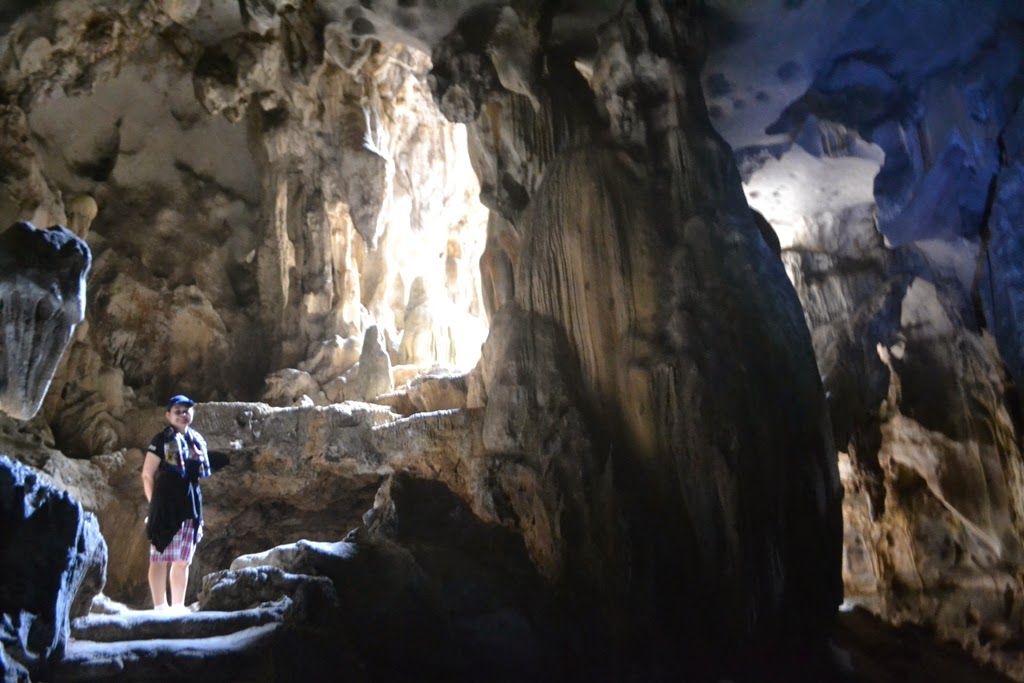
A favorite entrance is a grand opening between two large rocks that are around 30 feet high.  But in our case, it was the exit.  As you enter, you will see dome-like chambers, winding passages partially obstructed by stalagmites and stalactites and complemented with beautiful formations of shiny limestones. 
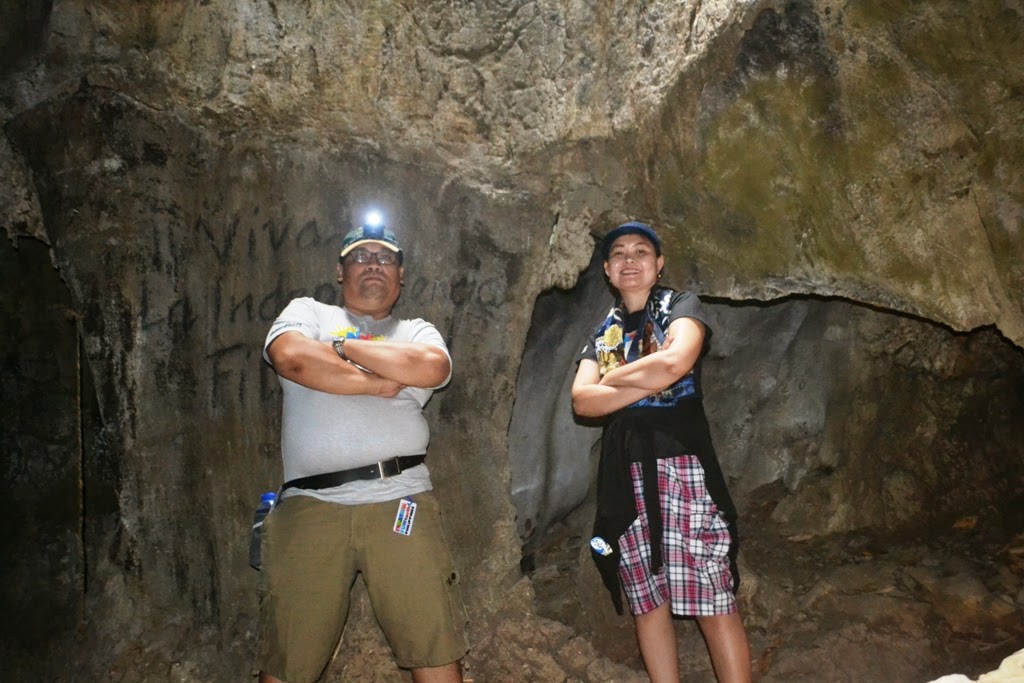
During the tour, the guide will also show areas where popular movie or television scenes were shot. Sadly, many walls have been wantonly vandalized while shooting movies, a practice that the local government tolerates. Some rocks through the years, changed colors, shapes and sizes. 
There are many openings through the cave ceiling where beams of light can be seem streaking through the dark cavern creating an amazing sight to behold.  Still there are other exits that will bring you under the church and even in neighboring towns.an area of the woods and even in neighboring towns! 
The entire network of Calinawan Cave is divided into 7 levels.  The regular tour will enable you to explore the levels 1 to level 3.  However, the guide would be requesting additional fee services if you still intend to explore the higher levels.  
Not wasting the opportunity to explore all the nooks and crannies of the cavern, I insisted to explore everything, but the guide said that we can only go as far as level 5 because level 6 and 7 and no longer accessible through traditional means.  
While exploring the deeper levels, we were able to see vertebrae-looking formations, stalactites dripping water and stalagmites that are just starting to form. Eat your heart out taking pictures and capture as many moments as you can for you might never get the chance to visit this place again in the near future. The regular 20-minute tour may stretch to hours depending on your selfie and groupie moments.
If you're wondering why the place was called Calinawan, this is the story.  The name does not date back in preHispanic times but became namesake for being the venue for settling disputes among Katipuneros during the Philippine Revolution, where feuding parties are enlightened or "nalinawan" regarding the circumstances leading to the feud.  This way they settle their differences in a civilized manner.
For the benefit of the everyone, this cave and other caves in the Philippines is protected by Republic Act 9072 or AN ACT TO MANAGE AND PROTECT CAVES AND CAVE RESOURCES AND FOR OTHER PURPOSES or otherwise known as the “National Caves and Cave Resources Management and Protection Act.”  It is hereby declared the policy of the State to conserve, protect and manage caves and cave resources as part of the country’s natural wealth. Towards this end, the State shall strengthen cooperation and exchange of information between governmental authorities and people who utilize caves and cave resources for scientific, educational, recreational, tourism and other purposes.
National parks and wilderness areas and caves such as this may be compromised by an influx of tourists. Impacts to culture may start to occur  such that ecotourism may displace some of the local residents. Either they won't be able to afford to stay, or they may be forced by developers to leave. 
In effect the growth of ecotourism attracts upper-class, urban tourists who may not be culturally sensitive and may alienate the local residents. Many ecotourism jobs for local residents often don't pay well and profits just spill into corrupt politicians' pockets as the cave's revenue increases.
After emerging from the cave, we begin to realize the historical and environmental lessons drawn from this experience.  People involved in its history and its contribution to the growth of the Filipinos' identity will forever become embedded in one's memory.  Most of all, we definitely marvel at the beauty of God's creation which is truly a gift to man and therefore carries a responsibility to nurture and ensure its sustainable future for the next generations to enjoy.  The experience of exploring Calinawan cave is truly a treasure of Tanay worth showing to the world! So come visit Calinawan and learn from its stories!

Thursday, April 2, 2015

PALO ALTO FALLS and PARK, REST and DINE: The 2Ps - Perfect Places in Baras, Rizal


Driving along the MariFanta Highway, one will pass by the town of Baras, a quiet town with not much places to go.  It was one of those byways in the highways where even a quaint stopover is nowhere to be found.  But hidden in the foothills of this oblivious hinterland town are two of its gems- the Palo Alto Falls and Park, Dine and Rest Restaurant.  I have read some blogs about this places but just pass them by whenever we frequent our favorite destinations in Tanay and Quezon.  On one our sojourns from the Sierra Madre, we decided to check out these places on the way home.
Pertinent to our topic on ecotourism this summer, perhaps ecotourism is the most over-used and miss-used word in the travel industry. But what does it mean? The Ecotourism Society defines it as "responsible travel to natural areas which conserves the environment and improves the welfare of the local people". A walk through the rainforest is not eco-tourism unless that particular walk somehow benefits that environment and the people who live there. A rafting trip is only eco-tourism if it raises awareness and/or funds to help protect the watershed. A loose interpretation of this definition allows many companies to promote themselves as something they are not. If true eco-tourism is important to you, ask plenty of questions to determine if your trip will help "conserve and improve" the places you visit.
A year and a half after Malen underwent chemotherapy for cancer, I was always trying to find ways of keeping ourselves physically fit and at the same time adding more excitement to it to maintain our positive outlook in life.  On the downhill drive from Sierra Madre our first destination was Palo Alto Falls.  The waterfalls is actually located inside a private subdivision that bears the same name.  The security was very cordial and allow passage of visitors eager to see the falls.  We were given directions where the jump-off point is and where to park the car.  Upon reaching the place, our initial assumption was that the place is probably developed for touring and we were actually correct in that.  They charge a hundred bucks for every visitor but is free of charge if you just want to see the falls, provided that you can do it and return back to the entrance gate within 15 minutes.  That's a pretty hard thing to do unless you're going to run uphill and run back as well.  Anyway, rules are rules and this is private property so they can implement their own policies freely.
When we saw the concrete walk leading to the falls, I felt a little sad that the owner had to alter the natural beauty of the place.  we kinda felt a little envy to those who had the opportunity to visit the place while it is still ruggedly pristine and untouched.  Now, we just have to contend with an artificial stairway leading to the falls.  Apparently, the owner had the senior citizens in mind to give them more opportunity to appreciate the beautiful falls as well.
The personnel at the jump-off point told us that the entire stairway to the falls has a total of 256 steps.  When we heard this, I felt pretty sure we can make it to the top.  But of course, there will always be a complaining remark from my ever bickering but loving wife.  I remembered the time when we trekked to Ambon-Ambon Falls, she kept asking me if the falls is already near, and time and again I would always assure her that it's just around the bend, even though we were both visiting the place for the first time.
I was glad that my words of assurance always convinces her to keep on going.  When I see a landing on the next level, I would tell her that upon reaching the landing, the remaining trek will be horizontal all the way to the falls.  I was praying I am correct when I said that, but when she reached the top first, she would give a sharp stare at me suggesting that there are still uphill steps to negotiate.  I just have to convince her that if I can do it, considering my size, she can definitely do it as well.  So we continue on with the climb.
 One of the things that I keep telling my wife during our adventure is to keep herself preoccupied with the beauty of the natural surroundings and not focus too much on the task of walking.  This way it keeps your mind off the physical challenge because nature's beauty is so powerful that gazing upon and admiring the intricacy of its beauty is enough to dispel all the aches and hardships of the journey.  The path to the falls is ruggedly beautiful with lush vegetation serving as its background and enormous boulders lay strewn along the downstream length of the almost dry streambed.
When we finally reached the falls, all the aches and weariness  dissipated as the cascading waters drenched our dry spirits and the cool water in the collecting pool below seems to extend and invitation to dive in.  We sat down to rest for a while and gazing our eyes on the surroundings.  
We were kinda disappointed because the owner really did a full blown development of the place.  The entire perimeter was already covered in concrete.  Even the pool where the falls drop is completely cemented.  
There were a mixture of concrete and nipa hut picnic sheds that can withstand a flashflood.  To our disappointment, We did not bother to shoot all these man-made structures.  We leave it to the future visitors to judge for themselves. 
When looking at the top of the falls, the water was already falling in trickles and this is just the beginning of summer.  From what I saw in the blogs I've read, water cascades down the entire width of its mouth.  Now only traces of water falls on the right side of the viewer.  The small volume of water is probably attributed to the degree of deforestation in the headwaters of the falls.  A watershed should be adequately covered with trees because the extensive root system of the vegetation is the one that retains water in the highlands and if trees disappeared in the upland, the impact on the watershed will be felt and seen in the amount of water feeding the falls.  It would have been spectacular if the output of water is at its maximum. It would have been a sight to see.  But with the increasing heat this summer, there might not be any water falling at all by that time.
Not dissuaded by the alterations to the natural beauty of the place, I seized the moment to take a dip in the cool waters of the pool since I was drenched in sweat climbing up this place.  In fairness, the water is clear and clean despite the low output from the falls so my experience in swimming in Palo Alto is what Filipinos would say "Palong-Palo" and pagligo sa Palo Alto!
Malen was reluctant to take a swim in the pool because although there are cubicles for changing clothes, there are no clean water to rinse your body.  The water coming out of the shower is the same water coming from the falls.  So she just settled being my photographer.  I decided not to rinse anymore and just change into a new set of clothes when we returned to the car.  As we began our descent, we can't help feast our eyes once more on the rugged beauty of the surroundings.

We enjoyed ourselves during the downhill climb as we frolic in the minifalls along the way.  We were the only ones in the path so we played like children mindless of the place and time because of the uninhibiting beauty of the surrounding forest.
What's the meaning of Palo Alto?  The name is translated in Spanish as "tall tree".  The original Palo Alto is in Western California where giant red trees dominate the land.  Here in the Philippines Palo Alto is a just but a mere wishful thinking of people still yearning of virgin forests in the Philippines.  Gone are those ecosystems as 400 years of colonial environmental degradation and present day capitalism and corruption has decimated much of the tall tree forest in our country. So we just have to settle for this wishful name at this point.  The forest around this place is no longer primary but a secondary forest dominated by young trees with some old survivors.
After changing into dry clothes, our next stop was the Park, Rest and Dine Restaurant along the downhill highway from Palo Alto.  We decided to have an early dinner in this quaint restaurant.  Upon entering dining area, we were greeted by a cozy ambiance where the interior is a mixture of wood and upholstery and highlighted by a fusion of local abd foreign decorations.  To top it all, the place is ideal for a romantic dinner for lovebirds small groups and intimate family gatherings.
The porch is centerpieced by a huge wooden table complemented with puka shell curtain as a sun shade.  The cool breeze of mountain air can be felt as you indulge yourself with the freshly cooked food of your choice.
We decided to try out their Sinigang na Hipon as we were not really hungry during that time.  Our visit to this restaurant was driven by curiosity from reading several blogs, where this restaurant was given recognition as "Bloggers' Choice" Award.  It's a fitting award for such a daring endeavor of its owner to build a halfway restaurant which isn't technically even halfway to whatever destination you will go.
The experience we had dining in this restaurant is quite different from the invited critiques who ate here.  We were not given a special treatment as important people but the waiter tried earnestly to serve us the best way he can. They gave a complimentary appetizer of mixed nuts and respond immediately to our call.
Overall, dining in Park, Rest and Dine was quite good but not enough for us to be returning in the near future. Though we won't impart unkind comments about the place, but we do feel it still need a little upgrading of the menu especially highlighting a cuisine which should be distinctly "Baras" original.  There should also be a form of entertainment throughout the open hours as long as there are customers so that they don't get uneasy waiting for their orders.  

Calabarzon is fast being encroached by the rapid urbanization of Metro Manila.  The hinterlands of Baras is now wide open for tourism and in the era of growing environmental awareness, ecotourism is now being used by many business entreprise as a tool for economic development.  But unless the true concept of ecotourism is used, all efforts in fostering this new concept will be a failure if business still insists of putting up financial gains first rather than environmental conservation and sustainable development.


Wednesday, April 1, 2015

DARANAK FALLS, Tanay: Spill Your Heart Out Before the Falls Trickles Out

On many occasions, the concept of ecotourism is widely misunderstood and is often used as a marketing instrument in order to promote tourism business related to nature.  Ecotourism means not only nature but indigenous cultures.  It is about fostering respect for nature and for cultures too.  True ecotourism represents travel to natural areas that conserves the natural environment and improves the well-being of the local people. 
I often view foreigners as good indicators of ecotourism.  Unlike local tourists who often demand satisfaction beyond what they have paid for - a measly amount for the fee and they start acting like they own the place because they thought that they had paid for the right to inflict impact on the environment, many foreigners are conscious of the impacts they create.  And when foreigners still visit a tourist spot in the Philippines, it's a good sign that the place still promises hope  despite the pressures of human exploitation.
I once read a blog about an Igorot local in Sagada where they despise local tourists because of how they behave in Sagada as if they own the place.  Filipinos park their vehicles in no parking zones without any regard for everyone who will be inconvenienced by their bullyish actions. They demand complete toiletries, towel and other hotel items for an overnight stay of 300 pesos - in a simple inn.  They shout at the top of their voices pretending to be the lead character of a popular local soap on tv without considering the annoying noises they impart on the neighborhood. It's just sad to think any local tourists visiting Sagada for the first time will be received with such hostility by the Igorot locals.  Foreign tourists are liked by the Igorots because they respect their way of life and easily assimilate with these indigenous people with the least environmental impacts. 
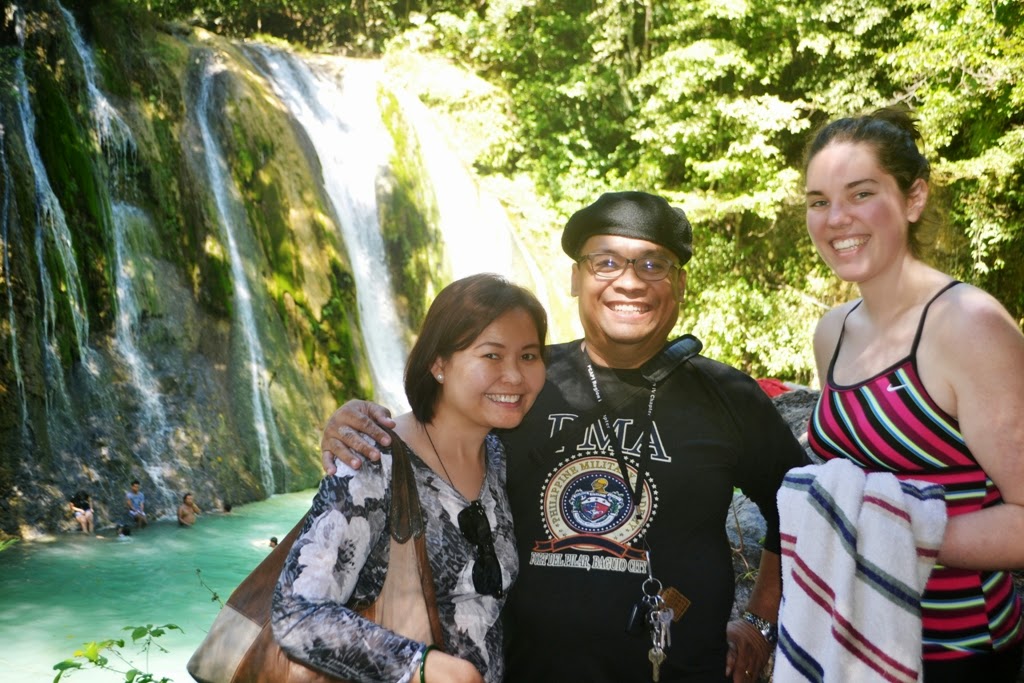
Going back to this place, Daranak Falls was named after the appearance of blood spilling over the sides of the cliff.  Hence, the "spilling blood" effect or in local language "danak ng dugo" which eventually evolved into the name "Daranak".  "Dara" in the indigenous Dumagat dialect means "water".  Therefore the name of the falls is a composite word that combines water and spill, thus the name "Daranak Falls".
Another unique feature of the falls is the innately green pool where the water cascades into.  It reflects the algae underneath but doesn't indicate eutrophication of its waters.  You jump in and you will find the water clear of any signs of organic pollution.  It was nice to see even the baby of the foreign tourist enjoying its clean cool waters.  The foreigners are actually missionaries on a brief break from their evangelical duties.  
Daranak Falls is actually the final descent of a two-tiered falls along the Daranak River.  The bridge over here leads to the path towards the upper tier which is Batlag Falls.  The falls is located within a private property where you have to pay another fee to visit the place.  Many movies had been shot on location in Batlag Falls, a popular one is the serial movies of "Ok Ka Fairy Ko" and "Enteng Kabisote".  We'll have the Batlag story in another blog.

Another attraction of the place is this Dao Tree which is a century old tree which has been spared from logging probably because of its advantageous location of being out in the open.  While those in the interior of the forest are the ones helplessly cut by insensitive people whose only concern is to profit in exchange for monetary gains.
Daranak Falls is best visited during the off-season where fewer people take time to visit the falls and bathe in its cool green waters.  The summer may not be ideal to visit the place because of its high accessibility to the public and the amount of water cascading from the falls only falls in trickles as the heat of summer dries up everything.  The full splendor of the falls can be seen during the rainy season when water falls in full blast and there's a strong chance that you may have the falls all for yourselves.
  In conclusion to our visit to this beautiful falls, ecotourism should foster a spirit of appreciation, participation and sensitivity.  We should practice a non-consumptive use of the wildlife and natural resources and revenues gained through visiting the site should should directly benefit the conservation of the site and economic well-being of the people. 
The pressing challenge of the local government in maintaining Daranak Falls is the observance of its carrying capacity.  There are many instances that the place is overcrowded. With the huge revenues that the place is getting, the funds for its conservation should be used wisely for future generations to enjoy it in the years to come.  The waters and trees of the place are the crucial components for its survival. There are also many other aspects to consider such as restoring the cultural identity of the indigenous Dumagats and the fauna that once flourish in this mountainous hinterland called Tanay.